Tuesday, April 7, 2009

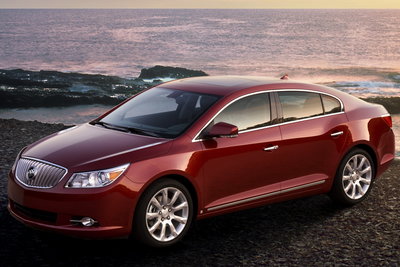
Buick LaCrosse CXS


New from the ground up, the 2010 Buick LaCrosse luxury sedan makes its world debut at the 2009 North American International Auto Show in Detroit on Jan. 11th The LaCrosse is all-wheel drive, a number of advanced technologies and intelligent personal safety, and a choice of two fuel-efficient V-6 engines.

“The new LaCrosse was a lot of attention to detail, craftsmanship and modern technology,” said Susan Docherty, Buick-Pontiac-GMC Vice President. “It builds on the success of the enclave, as the next step in the renaissance Buick. And as for Enclave, our goal is to create a whole new buyer for our dealer for LaCrosse.”

Sculpture Design

Buick long heritage of leading designs, such as the Y-Job Concept, the Road Master and the Cote d’Azur, helped define American automobile design over the years, according to Ed Welburn, Vice President of GM Global Design. Today, Buick design is a product of a global team and resources. Creative collaboration between designers in the United States and China, in collaboration with the Pan Asia Technical Automotive Center (PATAC) and Chassis Body and engineers in Europe, resulted in the first General Motors vehicle will be created on three continents. Click here for individual and Embed Videos
Click here to embed this player

“The new LaCrosse is to modern elegance,” said Welburn. “Throughout the design process, you will experience a balance of contrasts. Both the interior and exterior were in harmony with the spirit. The exterior balances taut, sensual sculptures accented with lines and surfaces. Inside, smoked chrome accents, warm wood, first class leather and materials are combined with cool blue ambient lighting to create a welcoming environment. ”

The exterior design is faithful to the Buick Invicta show car was introduced at the Auto Show in Beijing in 2008.  “It is immediately recognizable as a Buick, with its signature” sweep spear “body-side styling, Portholes characters in line on the bonnet, radiator grille and waterfall,” adds Welburn.

Luxurious interior experience

Inside are the two-tone interior is a flowing, without design theme that wraps around the instrument and door panels. Attention to detail is reflected throughout the body, including the analog instrument cluster with chrome accents of dark wood and the contrasting sewing thread and the French on the instrument panel display.

Buick signature Quiet Tuning - an engineering process to reduce, block and absorb interior noise - a distraction-free environment of persons. An unexpected, inviting touch is the cool blue ambient lighting throughout the cabin from the center console, dashboard and door trim.

Intelligent Personal Technologies

The contemporary atmosphere of the cabin includes digital connectivity and personal technology in the new LaCrosse. These include functions such as in-dash navigation, Bluetooth, an additional audio input and a USB port. For the rear passenger seats, a power rear window sunshade and a DVD entertainment system with two screens in the seat backs, is available.

LaCrosse Intelligent Technologies working for a 360-degree field of view behind the wheel, for a greater feeling of comfort, safety and security. It starts with the available head-up display in the windshield so the driver to monitor speed, while his or her eyes on the road. At night, the available adaptive lighting package can be connected directly to the high intensity discharge headlight beams up to 15 degrees for improved illumination of the road and its curves.

LaCrosse offers Side Blind Zone Alert reports that the driver when a vehicle in the adjacent streets is to travel in the driver’s blind spot. The LaCrosse is also equipped with a camera from behind, with the display in the navigation display.

Technology LaCrosse increased to a range of standard safety features, to meet the criteria for the National Highway Traffic Safety Administration (NHTSA) 20-star safety rating. Highlights are the front, side and roof-mounted head curtain airbags, StabiliTrak stability and traction control system. The safety and security of OnStar is also available for the first year of ownership.

Responsive performance

LaCrosse stiff the building serves as the basis for accurate suspension tuning, security and a quiet ride. Buyers can choose from a family of powerful, direct-injection six-cylinder engines and a fuel-conservation of the six-speed automatic transmission with tap-up/tap-down control.

The direct injection engines in the LaCrosse more power with less fuel consumption and emissions through greater control of combustion - especially in cold-start emissions, which increased by up to 25 percent.

Lotus Evora


The details of the new Lotus Evora have been released, albeit for the prototype version. Performance and consumption data are not yet known, although Lotus estimates a 257 km/h (160 mph) top speed and CO2emissions of under 255 g/km. 

The Evora is a completely new Lotus model, featuring a 3.6 litre V6 engine mounted ahead of the rear wheels. The chassis has been developed on Lotus' Low Volume Versatile Vehicle Architecture (VVA) system, which allows Lotus to develop various wheelbases, lengths and widths on one basic platform for different applications. The interior has 2+2 seating, although a purely 2 seater will also be available, accommodated within a 2575 mm wheelbase. Overall length of the body is 4342 mm, and it is 1223 mm high. The prototype has a kerb weight of 1350 kg, distributed 39%/61% between front and rear. A 0.33 coefficient of drag is claimed. 

A 3456 cc Lotus-tuned Toyota 2GR-FE engine, with Toyota's intelligent variable valve timing (VVT-i), is transversely mid-mounted. Lotus supply their own T6e engine management and a new exhaust system to provide power of 280 PS (206 kW) at 6400 rpm and torque of 342 Nm (252 ftlb) at 4700 rpm, as fitted in the prototype. A Toyota-sourced six speed manual gearbox is used. Front tyres are 225/40 ZR 18 and the rears are 255/35 ZR 19, with Yokohama having supplied a rubber unique to Lotus for this application. Stopping ability is catered for by ventilated discs front and rear, 350 mm and 332 mm in diameter respectively. An ABS system developed by Lotus and Bosch is fitted. 

The production Lotus Evora is expected to hit showrooms sometime in 2009. 

The Audi RS6 Saloon


The Audi RS6 Avant was launched some time ago already, and Audi have now released some details about the forthcoming Audi RS6 saloon. 

The saloon shares the overall dimensions with the Avant - a 2846 mm wheelbase, 4928 mm length and 1889 mm width. It is 4 mm lower than the Avant, at 1456 mm. It is also 50 kg lighter at the kerb, but still a heavyweight at 1972 kg. 

The brakes are ventilated discs fore and aft, with a diameter of 390 mm in the front and 356 mm at the rear, housed within 9J x 19 wheels. Tyre sizes are 255/40 R 19 on all four wheels. 

The engine is unchanged from the RS6 Avant, with a slightly undersquare (84.5 mm x 89.0 mm) 90 degree V10 sitting up front, with twin turbochargers helping the 4991 cc unit to provide 580 PS (427 kW) between 6250 rpm and 6700 rpm. Torque is an impressive 650 Nm (479 ftlb), achieved in a broad range from 1500 rpm to 6250 rpm. All this power is transmitted to all four wheels via a six speed Tiptronic gearbox. All this adds up to an electronically-limited 250 km/h top speed (optionally, it can be set to limit the maximum velocity to 280 km/h) and a 0-100 km/h sprint time of just 4.5 seconds.

Bugatti Veyron 16.4 Grand Sport


Pebble Beach saw the world premier of Bugatti's newest Veyron model, the Bugatti Veyron 16.4 Grand Sport. A removable roof adds open top motoring potential to the Veyron's list of capabilities. A lightweight transparent removable polycarbonate roof panel is fitted, necessitating a raft of changes to the monocoque of the Veyron to attain the requisite chassis stiffness, as the original fixed roof of the closed Veyron had provided some of its structural rigidity. There is no place to store the roof panel in the car when it is not in place, so Bugatti have supplied a folding canvas cover in the event that weather protection is needed once a journey is under way. Keeping the weight as low as possible was also a primary objective, and the roadster incurs just an 80 kg penalty. Other changes include redesigned front lights with daytime running LEDs, and a higher windscreen. Interior fittings have also been tweaked, with a new sound system being a prominent feature. 

Power is unchanged from the "normal" Veyron, the mid-mounted 8 litre W16 engine pumping out 1001 PS (736 kW) at 6000 rpm and 1250 Nm (922 ftlb) of torque between 2200 and 5500 rpm, thanks largely to 4 turbochargers assisting the breathing. The gearbox too is unchanged, a seven speed sequential gearbox with a fully automatic mode channeling that power to all four wheels. With the roof closed, Bugatti claim a top speed of 407 km/h for the Grand Sport, identical to its fixed top brother. the 0-100 km/h sprint is claimed to take under 2.7 seconds. When the folding canvas top is in place, top speed is limited to 130 km/h.

Ferrari Scuderia Spider 16M


Ferrari have released details on a new models that has been produced to celebrate the marque's 16th Formula One Constructors' World Championship, which they won this year. 

Based on the F430 Spider, the Ferrari Scuderia Spider 16M features upgrades from the 430 Sucderia. The 490 PS engine of the Ferrari F430 Spider is uprated to the 510 PS specification of the Scuderia. Torque is up marginally, from 465 Nm to 470 Nm, and the compression ratio is raised from 11.3:1 to 11.9:1. Power and torque peak at the same points in the range, at 8500 rpm and 5250 rpm respectively. The basic dimensions fo the engine remain unchanged, with a 92.0 mm bore and 81.0 mm stroke giving the 90° V-8 a swept capacity of 4308 cc. Mounted longitudinally amidships, this engine gives the Scuderia Spider 16M great performance, with the 0-100 km/h sprint taking a claimed 3.7 seconds, and allowing the car to attain a claimed 315 km/h top speed. Other modifications to the Scuderia Spider 16M over the standard F430 Spider bring the weight down to 1440 kg at the kerb, a saving of 80 kg. Overall height is down by 18 mm to 1216 mm, but the other major external dimensions remain as on the F430 Spider. CO2 emissions are 360 g/km. 

Braking is courtesy of ventilated carbon-ceramic disks, 398 mm at the front, and 350 mm at the rear. The 19 inch wheels are shod with 235/35 and 285/35 series Pirelli PZero Corsa rubber front and rear respectively. Suspension front and rear is via double wishbones and coil springs. 

The interior can be tailored through the Carrozzeria Scaglietti Personalisation Programme. The Scuderia Spider 16M will be made in a limited series of just 499 examples, with each bearing a commemorative plaque.

The Aston Martin V12 Vantage


Aston Martin have announced details of the new Aston Martin V12 Vantage. Here follows part of their official press release for it:

Agility and outright performance formed the basis of design for the V12 Vantage to produce the most exciting incarnation of the Vantage model line-up to date. Aston Martin’s most powerful engine is fused with its most agile model to produce a truly exhilarating sports car. 

The V12 power plant has been intelligently packaged into the Vantage’s compact form preserving its perfect proportions. While the external dimensions of the V8 Vantage remain unchanged, the internal front structure has been extensively revised forward of the suspension towers to house the larger engine, brake cooling system, and twin air intake system. 

The engine was designed at Aston Martin’s headquarters in Gaydon, Warwickshire, and is hand-built at the company’s dedicated engine facility in Cologne, Germany. To achieve the power output, the engine features a number of enhancements over the standard 6.0-litre V12 found in the DB9. These include a ‘by-pass’ engine air intake port that opens up at 5500 rpm, a revised induction system and re-profiled air inlet ports that further improve airflow into the combustion chamber to improve performance. 

The naturally aspirated 6.0-litre V12 hand-built engine produces 510 bhp (380 kW / 517 PS) at 6500 rpm and 570 Nm (420 lb ft) of torque giving the driver access to high levels of power and torque at all engine speeds. Unique to the V12 Vantage is a ‘Sport’ button which allows the driver to choose between two powertrain modes. 

The default ‘normal’ provides a more progressive, throttle response, suited to more everyday situations, such as driving in urban areas, heavy traffic, or in challenging weather conditions. Selecting ‘Sport’ mode delivers a sharper throttle response together with a sportier exhaust note. This mode is designed for use in more dynamic driving situations where sharper responses are required, extracting the maximum performance from the car. 

The V12 Vantage benefits from Aston Martin’s class leading all-alloy VH (Vertical Horizontal) architecture: a lightweight bonded platform that provides outstanding strength, rigidity and weight benefits. 

Although the V12 engine weighs 100 kg more than the standard car’s engine, intelligent use of lightweight materials and components including carbon ceramic brakes, lighter forged aluminium wheels, lightweight inner rear quarter panels and optional lightweight seats have resulted in the overall kerb weight being only 50 kg heavier than its V8 sibling. The ensuing weight distribution provides for balance that is near perfect (51:49). 

Exclusively available with a six-speed manual transmission, the gearbox uses a transaxle configuration to aid weight distribution. The V12 Vantage’s final drive ratio has also been modified from 3.909:1 to 3.71:1. This allows the Vantage to take full benefit of the high torque levels delivered by the engine to provide both flexibility at lower engine speeds as well as a high top speed of 190 mph. 

For a car possessing such racing pedigree, the V12 Vantage surprises with its day to day usability. Featuring a luggage capacity of 300 litres and a traditional tailgate, coupled with ample stowage space to the rear of the seats, touring and trips away are made easy. Gear changes are light and precise requiring minimum effort from the driver and a longer final drive ratio extracts the most from the power and torque available to improve driveability. The communicative chassis provides comfort on long journeys and thrilling feedback with energetic driving.